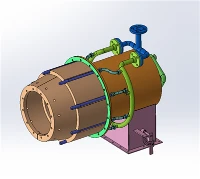
At Jiangsu Jufeng Thermal Energy Technology Co., Ltd., our core magnesium production is based on the widely adopted and reliablePidgeon Process. This systematic method is distinctly structured into three key stages:dolomite calcination, pellet reduction, and crude magnesium refining. This efficient and controllable workflow is why the industry recognizes it as the"Three-Step" Magnesium Smelting Process.

1. Raw Material Preparation & Calcination
The process begins with the high-temperature calcination of dolomite, converting it into more reactive calcined dolomite (a mixture of calcium oxide and magnesium oxide), preparing it for the subsequent reduction reaction.
2. Pelletizing & Vacuum Thermal Reduction (Core Reaction Stage)
The calcined dolomite is precisely mixed with a reducing agent (ferrosilicon) and a catalyst (fluorite) in specific proportions. This mixture is then ground into powder and pressed into compacted pellets. These pellets are loaded into specially madeheat-resistant alloy steel retorts. Under high temperatures of1150℃ – 1200℃ and a high vacuum of approximately10Pa – 20Pa, the reduction of magnesium oxide occurs, producing magnesium vapor.
3. Condensation & Refining
The magnesium vapor travels to thewater-cooled crystallization sleeve at the front of the retort, where it rapidly condenses into solidcrystalline magnesium (crude magnesium). Finally, this crude magnesium undergoes flux refining to remove impurities and is then cast into high-puritymagnesium ingots, ready for use in various industries.
- The Pidgeon Process offers a clear, stable, and well-established production route.
- The reaction occurs in a high-temperature vacuum, minimizing oxidation and yielding high-quality crystalline magnesium.
- The "Three-Step" structure allows for effective quality and energy consumption management at each stage.